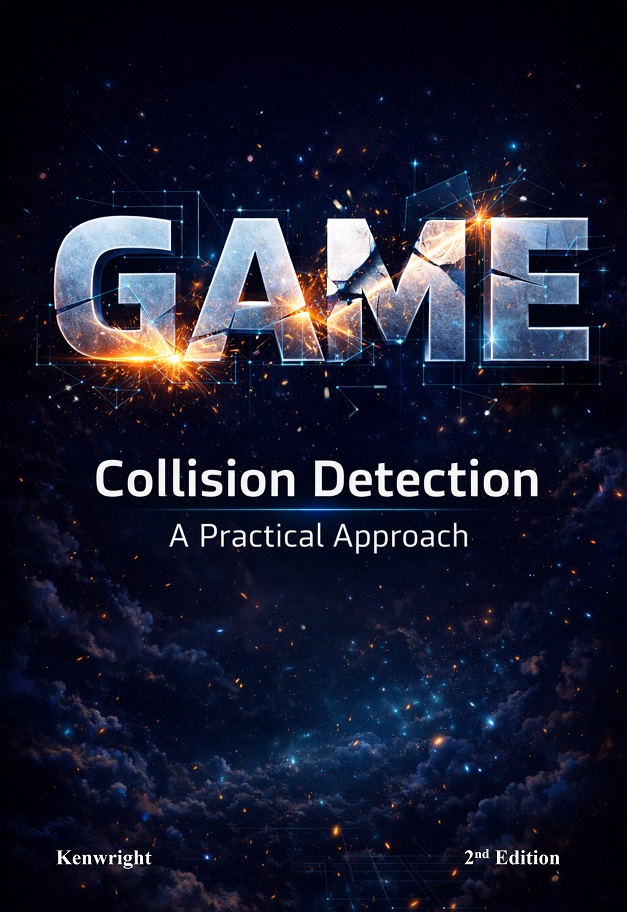
Game Collision Detection: A Practical Introduction
by Kenwright
Collision detection is a challenging and important multi-discipline problem in robotics, medical analysis and most importantly video games. Collision detection is not just a true or false answer to the question if two objects are touching, it is essential to detect the physical geometric data between objects and the environment accurately, such as, contact points, penetration depths, and separating normals. In fact, not only does the collision data need to be accurate for games, it needs to be fast. We explain collision detection algorithm principles and implementation details for use in interactive environments and physic-based simulators. We explain basic mathematical concepts and geometric principles (e.g., vectors, cross product, and plane equation). This textbook is designed to introduce the reader to the exciting topic of collision detection in virtual environments from a practical perspective. Organized around the central concept of collision detection, the book includes numerous practical examples in the body of the text as well as explaining technical limitations and engineering solutions. It is also one of the purposes of this book to introduce the reader to the development aspect of game and real-time interactive software.
| Publication date | January 28, 2026 |
|---|---|
| Pages | 248 pages |
| Language | English |
| ISBN | 9798246414033 |
| ASIN | B0GKY5558F |
What you get from it
- Master practical coding skills.
- Explore real-world projects.
- Accelerate your learning curve.
- Demystify advanced technical topics.
Full synopsis
Game Collision Detection: A Practical Introduction offers a comprehensive and in-depth guide that walks you through the concepts, applications, and best practices. With a strong focus on hands-on examples and real-world relevance, it empowers you to not just learn the theory but to apply it in meaningful ways across graphics, compute, and more.A superb guide
Rating: 5
— The Institute