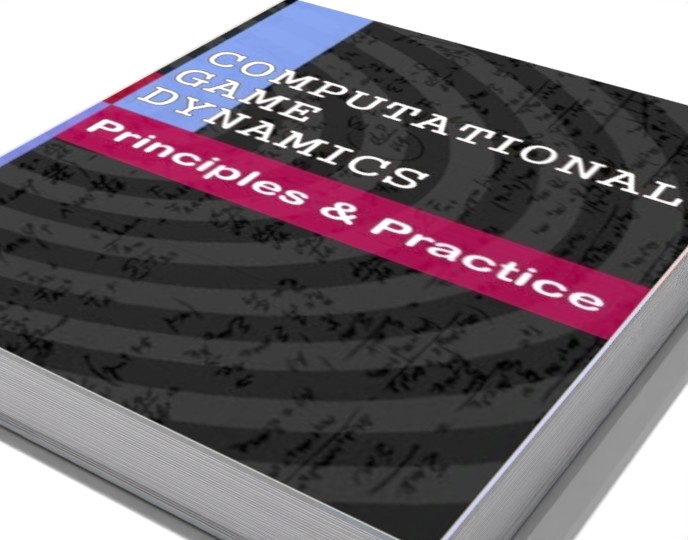


Computational Game Dynamics
by Kenwright
Game dynamics has become increasingly important over the past few decades with the growth of computational power and the need to develop more realistic, engaging, and interactive environments. Computational Game Dynamics: Principles & Practice, presents an introduction to dynamic simulations for real-time gaming environments. We show simplified implementation examples in conjunction with key theoretical concepts to help the readers gain a practical understanding, while outlining pitfalls and engineering challenges. The readers are acquainted with basic principles all the way through to testing and coding practices. Numerous illustrations and explanations of working situations are presented to help the readers grasp particular fuzzy and thought-provoking topics. The book is organised into eight chapters that present a beginners introduction to core theories and their application in real-world physics-based problems that include collision detection, particles, rigid bodies, multi-body dynamics, and vector mathematics. Each chapter features simple examples that show the main ideas and procedures, as well as straightforward problems to facilitate learning and help the readers build a practical problem solving skills.
| Publisher | CreateSpace Independent Publishing Platform |
|---|---|
| Publication date | January 1, 2015 |
| Pages | 108 pages |
| Language | English |
| ISBN | 9781501018398 |
What you get from it
- Master practical coding skills.
- Explore real-world projects.
- Accelerate your learning curve.
- Demystify advanced technical topics.
Full synopsis
Computational Game Dynamics offers a comprehensive and in-depth guide that walks you through the concepts, applications, and best practices. With a strong focus on hands-on examples and real-world relevance, it empowers you to not just learn the theory but to apply it in meaningful ways across graphics, compute, and more.Clear, thorough, and genuinely useful
Rating: 5
— The Institute